
In 2011 I wrote a short essay called the Seven Ages of Genocide Testimony and then applied it to the case of genocide perpetrated by Russia against Ukraine in the 1930s. You can read the 2011 article for Ukraine Weekly here.
The events in Ukraine since the full-scale invasion have both challenged and reshaped my presentation of the seven ages of genocide testimony. On the positive side, the Ukrainians have not waited for the killing to end before naming the crime and seeking judgment and punishment. This proactive stance defies the usual delays in recognition and response, as they demand accountability while the atrocities are still unfolding. On the negative side, however, the current age of impunity continues to undermine justice. The international legal system has failed in Ukraine, just as it has failed in Palestine, to adequately protect victims and hold perpetrators accountable. This systemic failure exposes the gaps between international law’s promises and its capacity to prevent or punish these crimes in real time.
Since the full-scale invasion the Ukrainians have made the case with increasing force that Russia’s project in Ukraine is both Imperial and genocidal. That case was first discussed in 2014 but has a longer history that is rooted in the history of the Soviet Union and the attitudes of Russians to national groups within the Russian Empire. In returning to the Seven Ages of Genocide, I want to consider the events since the full-scale invasion but I am very conscience that the history of this genocide has much deeper routes.
Ukraine Revisited. Genocide in Our Midst
Seven Ages of Genocide Testimony in Ukraine: Revisited
In 2011 I wrote an short essay called the Seven Ages of Genocide Testimony and then applied it to the case of genocide perpetrated by Russia against Ukraine in the 1930s. You can read the 2011 article for Ukraine Weekly here.
This was the original short essay:
Before the testimony there is the crime. The crime happens because of stories and words. A country is pregnant with genocide for a long time before the actual killing begins. Ideas are written, spoken and argued over. Ideologies evolve from these conversations about ideas. Ideologies target a group of people. They give this group an identity they cannot escape – how can you stop being a Jew or a Tutsi. The followers of these ideas come to control the state. They then put into practice their ideas. They will not live on the same planet as the other, usually, an “other” which is within the same state. Always an “other” that includes all members from the smallest children to the oldest grandparent. In all genocides, words give shape and meaning to the idea of annihilation before it takes place.
There are also many places where the same soup of prejudice, hate, half-baked philosophy, scapegoating and malice never gives birth to mass murder. In cases where it does the words of hate find a voice to carry them forward to fruition by gaining control of the state. In all genocides there is agency. Context and history matter. However, for genocide to take place there must be individuals who decide that this is what should happen now. Agency gives birth to extermination; words give individuals the power to act. They make the enemy legible and the murder meaningful. Without words and ideas genocides do not take place.
There are discourses of hate that do not lead to genocide. There are instances of mass killing that do not come to be called genocide. When the event has taken place there must be a naming of that event. A consensus that this particular bout of human hatred is one thing and not another: words come into play again. The baptism of an event as a genocide became possible after 1944 when the word was coined. It was given legal meaning in 1948 when the convention was passed. It has since become a hugely contested area of geopolitics. What name do we give the killing of this group of people by their state or this population by an invading state?
The first two stages in the life cycle of a genocide take place before a victim’s voice is heard. While the genocide is taking place the decisions about what to call it are not made in response to the testimony of the victims. Rather the mass killing is first a geopolitical event. Its status is determined by the status, position, importance of the location of events and the context in terms of other events in which it is taking place. Some voices might begin to be heard but almost always it is after the event that the witness comes to the fore.
The early years after a genocide are the childhood and adolescence of the event. They are the period in which the witness voices begin to be heard. They are heard, recorded and formed through a range of genres and in a range of ways. Evidence is collected to contribute to the bringing of cases to the ICC and evidence is taken from victims who have fled to establish if they are real refugees or not. Formal evidence collection brings the voice of the victim, the words of the victim, into contact with the first of a myriad of interconnecting, sometimes competing and different cycles. This first is the legal cycle. It is slow, cautious and driven by what is and can be recorded, cross checked and verified. Whether it is the evidence of the victim about the perpetrators or indeed the evidence of the victim about themselves, facts become key; these facts can be challenged in court, the testimony can contradicted, there is insecurity, there is fresh trauma and there is the fallibility of memory. Victims must prove themselves either to ensure that their perpetrators are judged and maybe also punished, but also to establish their own identity, status and position as victims. Much of this evidence will emerge from and repeat private or closed discourses within the victim communities and in their own languages rather than any international lingua franca. These closed discourses in diaries, letters, family discussions and community newspapers, for example the US Yiddish and Hebrew press of the 1940s and 1950s, is often dominated by survivors trying to find each other, trying to find who has lived and who has died. They are full of stories of escape and stories of destruction. They are raw and the stories are then repeated for immigration and UN officials, in court cases, in application for pensions and reparations.
Gradually the stories and testimony mature. The private cycles of community discourse and the slow-moving cycles of legal process are intertwined with political cycles of interest and disinterest. They are intertwined with news and media cycles of interest and indifference. They are intertwined with generational cycles comprising the questions of children and grandchildren. They are intertwined with the cycles of historians and the opening of the archives and the writing of the history. A process of hegemony of a narrative can take place. A mature story emerges which was once fresh and exciting, gradually fades from view. Perhaps the world pays attention for a time but then gradually the story becomes old. The interconnected wheels of news, politics, and history shift and the testimony becomes overly familiar, too often heard and slowly it begins to be ignored. The court cases finish or slow to a stop. The news organisations refuse stories, the movies stop being made, the books are no longer published. New genocides emerge and new causes develop. The story dies. But it does not disappear.
In the digital age there is a permanent afterlife. The story sits in this digital heaven and can have new life breathed into on occasion. But in essence, outside the closed discourses of the victims themselves, their families, their sites of memorialising, unless a political cycle needs to revive it, the story has been told.
Genocide in our Midst
Before the testimony, there is the crime, and before the crime, there are the words. Genocides do not erupt spontaneously; they are cultivated through a long period of ideological seeding. Words are spoken, written, and debated until they crystallize into ideologies that define and target specific groups, and they hide behind euphemisms that seek to hide crimes as they are carried out. In Ukraine, this process is no different. The Russian war on Ukraine provides a stark reminder that words can be weaponized to deadly effect, preparing the ground for violence by dehumanizing the target group and framing atrocities as necessary. And words can reshape global opinion of a war of aggression and minimise the crimes that flow from that act of aggression.
The origins of the term “genocide” itself are rooted in the recognition of the power of words. Raphael Lemkin, the Polish-Jewish legal scholar who coined the term in 1944, saw language as a critical tool for understanding and preventing the destruction of groups. Lemkin’s conceptualization of genocide always went beyond mere physical annihilation to include the destruction of culture, language, and social cohesion and therefore identity. He initially used the terms “barbarity” and “vandalism” to describe the destruction of human groups, with “barbarity” representing the physical destruction of people and “vandalism” encompassing the destruction of cultural symbols and heritage.
Lemkin’s concept of genocide, as it developed, emphasized that genocide is not just about the acts of violence themselves but about the broader intent to cripple a group’s ability to exist and function as a social and cultural entity. His reflections on the genocidal actions of the Nazis underscore that genocide is both the erasure of identity and physical extermination. This ideological framing is critical for understanding how genocidal violence comes to be justified. The Nazi propaganda that dehumanized Jews and other targeted groups laid the groundwork for the industrialised mass murder of the Holocaust, much like Russian rhetoric dehumanized Ukrainians and their national identity and created high levels of support in Russia for waging war on the Ukrainian people.
Russian propaganda has employed terms like “denazification” to justify its full-scale invasion of Ukraine, despite the absence of any credible evidence supporting these claims. As Egbert Fortuin outlines, Russia has repeatedly accused Ukraine of committing genocide against Russian speakers in the Donbas, portraying Ukraine’s democratically elected government as a Nazi regime intent on eradicating Russian culture and identity. Fortuin shows how the term emerged over time: “genocide is construed and used as part of the larger frame Russophobic Nazi Ukraine government commits genocide on Russians, showing how this frame developed over time in five stages:
- Embryonic stage in post-Soviet Russia and the Donbas in Ukraine;
- Emergence of the “Nazi-genocide” frame in Ukraine (2003–2014);
- Lessons learned by Russia from the coloured revolutions (2003–2014);
- Full-blown development and Russian use of the entire “Nazi-genocide-Russophobia” frame for Ukraine (2014–2022);
- Final stage: war against Ukraine (2022) and encouragement of the Russian army to commit atrocities against Ukrainian civilians.”[1]
This rhetorical framework serves several purposes: it justifies the invasion to a domestic Russian audience, garners support from specific international groups or at least allows those entities to something to hide behind and distorts the reality of the situation to deflect attention from Russia’s own war crimes. In the west, these strategies have been successful in states like Hungry and Austria and are reflected in the electoral performance of parties that accept the Russian narrative. Outside Europe, they are often accepted as true and as the evidence for rejecting the colonial dimension of the war.
Such language does more than distort facts—it actively dehumanizes the Ukrainian people, paving the way for both cultural and physical genocide and frames the war on Ukraine by Russia as justified. Fortuin emphasizes how terms like “genocide” are systematically employed by Russian media, politicians, and even President Vladimir Putin himself to reshape public perception. This manipulation of language mirrors strategies used in previous genocides, such as the Nazi regime’s portrayal of Jews as a racial threat or the Hutu leaders’ dehumanization of the Tutsi population during the Rwandan Genocide. By labelling Ukrainians as Nazis and their government as genocidal, Russia creates a moral framework that legitimizes the violent erasure of Ukrainian culture, language, and people.
Putin’s exploitation of historical analogies, particularly invoking NATO’s interventions in the Balkans, further serves to provide a pseudo-historical legitimacy to Russia’s actions. As Shpend Kursani argues, Putin likens Russia’s invasion of Ukraine to NATO’s peacekeeping missions, blurring the moral lines and equating Russian aggression with legitimate international interventions. This distortion of historical events, coupled with terms like “denazification,” aims to justify the systematic eradication of Ukrainian identity, much as genocidal regimes throughout history have manipulated language to frame their violence as necessary for self-defence.[2]
In this context, words are not mere descriptors of conflict—they are weapons that precede and enable the violence that follows. The distortion of terms like “genocide” not only undermines international legal frameworks but also erodes the very meaning of the word, making it harder for the global community to respond to genuine cases of genocide. Russia’s manipulation of this language obscures its own genocidal actions in Ukraine, from forced deportations to the systematic Russification of occupied territories. The ideological seeds planted by Russian rhetoric have born deadly fruit, illustrating the crucial role that language plays in the process of genocide.
One of the defining characteristics of genocide is the systematic identification and targeting of specific groups based on their ethnicity, nationality, or political beliefs. These early stages often involve not only physical violence but also methods of control and repression that isolate and stigmatize the target population. In Ukraine, Russian forces have implemented a “filtration” system in the occupied territories, which involves invasive interrogations, biometric data collection, and physical inspections. This filtration system is used to identify individuals deemed loyal to Ukraine or resistant to Russian occupation. As described by Shapovalova and Fedorovska, this process serves as a critical tool for eliminating pro-Ukrainian individuals, suppressing dissent, and erasing Ukrainian national identity.
The filtration process employed by Russian forces echoes historical genocidal tactics, particularly through the use of camps, checkpoints, and detention centres to control, detain, and in some cases, eliminate civilians. This approach aligns with the frameworks of Nazi Germany and the Stalinist Soviet Union, where the identification and segregation of certain groups were precursors to broader elimination efforts. In Nazi Germany, Jews, political dissidents, and minorities were subjected to invasive identification and marked for extermination. Similarly, Stalin’s Gulag system targeted political opponents and ethnic minorities for suppression through forced labour and detentions, a legacy of repression mirrored in Russia’s current tactics in Ukraine.
In the occupied territories of Ukraine, civilians are subjected to a brutal filtration system designed to assess their loyalty. Individuals undergo interrogations about their political affiliations and personal histories, with any signs of pro-Ukrainian sentiment, such as tattoos or social media activity, resulting in further detentions, violence, or worse. Those deemed disloyal to Russian rule may face torture, detention, or forced deportation. This system not only seeks to eliminate Ukrainian loyalists but also acts as a tool of terror, coercing civilians into submission and breaking down resistance to occupation.[3]
In Ukraine, the filtration system appears as a mechanism of state-sponsored terror that sows fear among civilians, discouraging resistance through the brutal application of violence. This system also targets specific demographics, particularly Ukrainian children, who have been forcibly deported or assimilated through Russification efforts—acts that can be classified as cultural genocide. The identification and forced assimilation of Ukrainian children aims to destroy their cultural heritage and identity, a hallmark of genocidal campaigns. The 1948 Genocide Convention includes in its definition not only the killing of members of a national, ethnic, racial, or religious group but also the forcible transfer of children with the intent to destroy that group’s identity. The deportation of Ukrainian children and their subsequent Russification efforts are a deliberate strategy aimed at erasing Ukrainian identity, constituting an act of cultural genocide .
According to the analysis in The Taken Children of Ukraine, these deported children are subjected to a systematic process of Russification. They are placed in Russian foster families, where they are stripped of their Ukrainian heritage, language, and identity, and are instead re-educated in the ways of Russian culture. This forced assimilation has clear genocidal intent as it seeks to erase the cultural and national markers that define these children as Ukrainian. By doing so, Russia is not merely attacking Ukraine’s present statehood but is actively working to destroy its future by targeting the next generation.[4]
The forced deportation and Russification of Ukrainian children mirror the practices seen in other genocides and in the conduct of other wars, where the erasure of a group’s identity was central to the genocidal strategy. For instance, the forced assimilation of Indigenous populations in North America through the residential school system sought to eliminate Native cultures by removing children from their communities and indoctrinating them with Western values. Adoption has also been weaponised to achieve political ends:
During and after the Spanish Civil War 1936–1939 under Franco, tens of thousands of children, known as the Lost children of Francoism, were taken from parents deemed to be political enemies (Anderson, 2017). Babies were taken from their imprisoned mothers at birth and adopted by families of the regime or placed in orphanages (Richards, 2005). Children were raised to believe lies about their families and hold them in contempt. In a 1940 study, 72 percent of these children were found to disapprove of the morality of their birth parents due to indoctrination (Richards, 2005).[5]
Similarly, in Argentina’s Dirty War, the abduction of children from political dissidents followed a similar trajectory, with the state systematically erasing the identities of the children and raising them within families loyal to the regime. These historical precedents emphasize that genocide is not solely defined by mass killings but also involves the destruction of cultural, national, and ethnic identities.
In Ukraine, this cultural erasure is not limited to the deportation of children. It also manifests in the destruction of cultural landmarks, the suppression of the Ukrainian language, and the targeting of cultural and religious institutions central to Ukrainian identity.
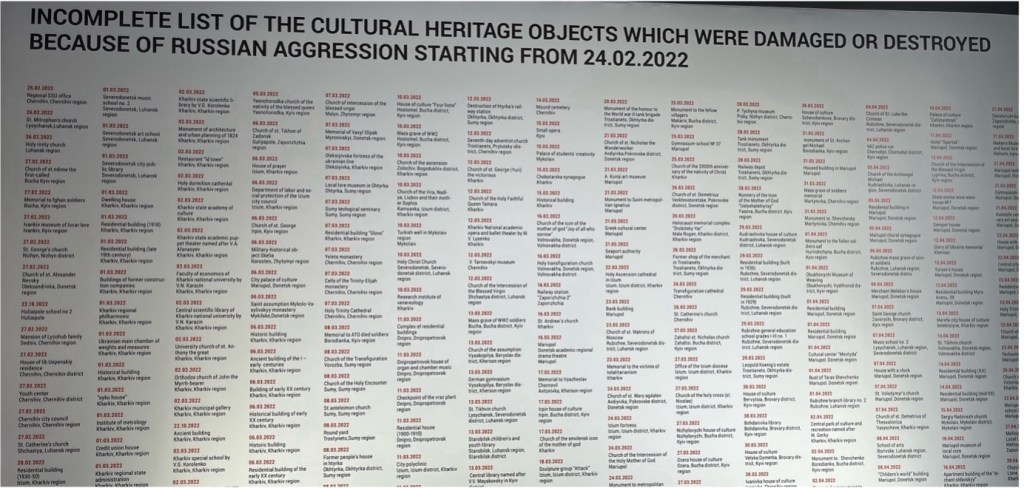
This display was in the entrance of the American University in Kyiv in September 2023 when I visited. Russian forces have systematically attacked Ukrainian cultural sites, including libraries, museums, and churches, as part of their broader genocidal campaign. The deliberate destruction of cultural property is a clear violation of international law, particularly the Hague Convention for the Protection of Cultural Property in the Event of Armed Conflict, to which Russia is a signatory. These acts are part of a larger strategy to erase Ukraine’s cultural heritage, solidifying the genocidal nature of Russia’s actions but also making clear the underlying Imperialism of the Russian war.
Beyond the physical destruction of cultural sites, there is a concerted effort to suppress the Ukrainian language and educational systems in the occupied territories. Russian forces have replaced Ukrainian curricula with Russian ones, erased Ukrainian history from textbooks, and banned the teaching of the Ukrainian language in schools. These measures aim to reprogram the population, particularly the youth, to identify with Russia rather than Ukraine, thereby eradicating their national identity. This educational Russification is another manifestation of cultural genocide, as it seeks to erase the distinct Ukrainian identity and replace it with a Russian one.
The parallels between these actions and previous genocides, such as the treatment of Bosnian Muslims during the Bosnian War, Armenian Christian in Azerbaijan, or the Soviet deportations of the Crimean Tatars, further underscore the genocidal intent behind Russia’s campaign in Ukraine. In Bosnia, the destruction of cultural and religious landmarks was part of the ethnic cleansing strategy used by Serbian forces, who sought to erase the Muslim identity of the region. In the same way, Azerbaijan is systematically destroying the Christian Armenian cultural identity in Nagorno Karabakh. Similarly, Stalin’s mass deportations of ethnic groups like the Crimean Tatars aimed to dissolve their national identity and integrate them into the Soviet state. In each case, as in Ukraine today, the erasure of cultural identity was not incidental to the violence but a core component of the genocidal strategy.
Russia’s actions in Ukraine suggest a coordinated and systematic effort to eradicate Ukrainian identity. As the International Criminal Court (ICC) has noted in previous cases, genocide often begins with the intent to “destroy the essential foundations of the life of national groups,” including their culture, language, and traditions. The ICC’s issuance of arrest warrants for Russian officials, including President Vladimir Putin, for the forced deportation of Ukrainian children highlights the gravity of these actions. However, the recent failure to arrest Putin during his visit to Mongolia underscores the ongoing challenge of enforcing such warrants against Heads of State. The court’s involvement signals that the international community views these acts not just as war crimes but as part of a broader genocidal strategy to erase Ukraine’s national identity.
The prosecution of genocide within the international legal framework, particularly in the context of Russia’s war on Ukraine, continues to face evolving legal, political, and practical obstacles. Ukraine has sought justice through international bodies such as the International Court of Justice (ICJ) and the International Criminal Court (ICC). However, proving genocidal intent under Article II of the 1948 Genocide Convention remains a major challenge. Legal scholar William A. Schabas has pointed out that both sides in the conflict have politically misused the term “genocide,” often using it as a rhetorical tool rather than a precise legal accusation. This overuse complicates legal proceedings and impacts the broader understanding and memory of genocidal events. Consequently, while international courts seek to address these grave crimes, the loose application of the term can hinder efforts to achieve justice and maintain clarity in such prosecutions.
Schabas’ emphasis on the difficulty of proving intent underscores that this is not merely a legal hurdle but a conceptual one, influencing how such events are classified and remembered in both historical and legal discourse. The evolving international legal framework around genocide, as seen in past cases like Bosnia and Rwanda, provides important context for Ukraine’s current legal strategies, particularly in shaping post-conflict recognition and justice. Schabas’s arguments are important, but he makes a significant category error in comparing the two parties to the conflict. Russia’s actions are part of a coordinated genocidal plan against the Ukrainian population with a clear intent to destroy a national, ethnic, racial, or religious group in whole or in part. The category error is to place the state guilty of the crime of aggression on the same level as a state which has been invaded. Russia’s justification, framed as a form of humanitarian intervention, lacks any credibility in international law. The success of prosecuting genocide remains contingent on substantial evidence collection, particularly from survivors and witnesses in Ukraine. Ukrainian authorities and international organizations are working to gather testimonies from survivors of filtration camps, deported children, and witnesses to mass executions, all of which are crucial in proving the broader genocidal context. Ukraine has made strides in seeking justice for Russian atrocities, the legal hurdles remain daunting. The ICC, ICJ, and potential Special Tribunals will all play key roles, but establishing genocidal intent and ensuring international cooperation will be critical to overcoming these obstacles. The outcomes of these cases will likely set precedents for how future genocides are prosecuted, particularly in cases involving state actors like Russia.
Genocide does not end when the killing stops. The trauma inflicted on survivors, families, and entire societies can last for generations, leaving indelible scars that reshape the cultural, social, and psychological fabric of the affected groups. In Ukraine, the trauma from the Holodomor—Russia’s man-made famine in the 1930s that killed millions—continues to resonate deeply, shaping national identity and consciousness. Studies of the intergenerational transmission of trauma reveal that the descendants of Holodomor survivors inherited coping mechanisms rooted in fear, mistrust, and a scarcity mentality. These traits were passed down through generations, exemplifying how genocidal trauma is embedded in the collective memory of a nation, influencing how it reacts to new threats and struggles for survival.
The current war by Russia on Ukraine, with its forced deportations, filtration camps, and widespread mass killing, will undoubtedly leave a similar mark on future generations. Russian forces’ actions, such as the forced assimilation of Ukrainian children, the destruction of cultural landmarks, and the systemic use of filtration camps to root out pro-Ukrainian sentiments, will shape the country’s national psyche for decades to come. One significant aspect of trauma is how it is processed and remembered through testimony. Testimony is not only a legal tool for holding perpetrators accountable but also a vital mechanism for preserving the memory of atrocities and ensuring that future generations understand the full scope of the crimes committed. The documentation of war crimes, genocide, and crimes against humanity through survivor testimony is well underway in Ukraine, with organizations and legal bodies collecting detailed accounts of atrocities to be used in future prosecutions. These testimonies will play a crucial role in shaping how the world remembers Russia’s actions in Ukraine, much like the survivor testimonies from the Holocaust, Palestine, Rwanda, and Bosnia have shaped the global understanding of those genocides.
The ongoing conflict is producing new layers of trauma, particularly for those who survive the brutal practices of filtration camps. Survivors of these camps are left with profound psychological scars, including anxiety, depression, and post-traumatic stress disorder (PTSD). These effects will likely be passed down to their children and grandchildren, mirroring the patterns seen with the Holodomor, where the trauma of scarcity and repression became interwoven into family narratives. The impact of this trauma on the Ukrainian collective memory will also influence how the country reconstructs itself after the war. The memory of the atrocities committed by Russian forces will become part of Ukraine’s national narrative, much like the memory of the Holodomor has become a symbol of Ukrainian resilience and the struggle for independence. As the historian Timothy Snyder has pointed out, collective memory plays a crucial role in nation-building, particularly in post-conflict societies where trauma becomes a foundational element of national identity. In this context, the trauma of the current war will likely shape Ukrainian identity for generations, reinforcing a sense of unity in the face of foreign aggression and underscoring the importance of preserving Ukrainian culture and sovereignty.
The psychological toll on survivors of filtration camps, forced deportations, and other acts of violence will require long-term strategies for mental health recovery and trauma-informed care. As research from other post-genocidal societies has shown, trauma can manifest in various ways, including substance abuse, domestic violence, and social withdrawal. The government and international organizations will need to invest in mental health infrastructure to help survivors heal and rebuild their lives. Initiatives aimed at documenting trauma, providing psychological support, and offering pathways to justice will be critical in preventing the trauma from festering and further destabilizing Ukrainian society.
The genocide and war crimes in Ukraine will leave deep psychological and cultural wounds that may take generations to heal but they will not be forgotten. The families of those killed, the survivors of forced deportations, filtration camps, and cultural erasure will bear lasting trauma, shaping both the country’s recovery and its collective memory which has already been shaped by the speed with which the collection of evidence began after 2014. Testimonies will be crucial, serving as legal evidence and a means of processing the trauma. As Ukraine continues to document these crimes, survivors’ voices will ensure these atrocities are neither forgotten nor misrepresented, reinforcing the importance of justice and remembrance.
Denial and justice are deeply intertwined in the aftermath of genocide, where perpetrators often manipulate historical narratives to evade responsibility. In Ukraine’s case, Russian officials have consistently denied war crimes and genocidal acts, employing deflection tactics that follow a familiar post-genocidal pattern. Russian propaganda frames the invasion as a “special military operation” to protect Russian speakers from alleged genocide by Ukraine. This narrative portrays Ukraine as a Nazi state committing genocide against Russians in Donbas, not only justifying Russia’s actions but deflecting blame. Russian officials and media use selective facts, such as language laws affecting Russian speakers, while distorting the juridical meaning of genocide and conditions in Donbas. This manipulation, rooted in Russia’s strategic use of language and historical analogies, particularly World War II rhetoric, casts Ukraine as a Nazi state to justify its actions. Such historical revisionism is common in genocidal aftermaths, as seen in Serbia’s denial of the Srebrenica massacre and Turkey’s ongoing refusal to recognize the Armenian Genocide.
The “seven ages of genocide testimony” provide a powerful framework for understanding how the war in Ukraine, much like previous genocidal events, will be remembered and contested. The stages of genocide—from the ideological groundwork and the acts of mass violence to the denial and eventual testimony—reveal the crucial role that survivor accounts will play in shaping Ukraine’s national narrative and the pursuit of justice. Testimony, as both a legal and cultural artifact, preserves the voices of those who lived through atrocities, ensuring that their experiences are neither erased nor distorted. In Ukraine’s case, the trauma of forced deportations, filtration camps, and cultural erasure will resonate for generations, mirroring the long-lasting scars left by past genocides, such as the Holodomor. Just as Holocaust survivors shaped global understanding of those atrocities through their testimonies, the stories of Ukrainian survivors will be vital in countering Russian denial and securing accountability through international courts.
However, as with all genocides, denial and manipulation of history pose significant challenges. Russian propaganda, which frames its invasion as a defense against alleged genocide by Ukraine, exemplifies the use of language to justify violence and obscure the truth. This distortion of history is a familiar tactic seen in the aftermath of genocides in Bosnia and Armenia. As Ukraine continues to collect evidence and testimonies, the process of memorializing these events will not only contribute to healing but also serve as a safeguard against the erasure of truth. Through the intergenerational transmission of trauma and the preservation of testimony, the memory of these crimes will persist, underscoring the enduring importance of justice and recognition in post-genocidal societies.
We must recognize and continually remind ourselves that this is happening in the heart of Europe right now. As in Bosnia, there is no great distance behind which our indifference can hide. The evidence is undeniable and readily available to expose the lies of the Russian disinformation machine. Yet, even with the ability to know the truth, it may not be enough. The industrial scale of deception surrounding Russia’s war on Ukraine creates a constant sense that the truth might be drowned out or forgotten in a hastily imposed peace settlement. This relentless barrage of falsehoods makes it feel as though the reality of Ukraine’s suffering could be overshadowed or erased, leaving the world to move on without justice being served.
It feels that right now is the moment of the bystander. There are inflection points in conflict and genocidal campaigns at which the actions and the inactions of the bystander can determine the course of the killing and the construction of the meaning of that killing afterward. For the parents of the taken, for the families of the killed, this feels like a moment at which the world is turning its gaze away. In that turn, in that inflection, voting in the US, shifts in Germany, Chinese and Gulf peace plans, there is the opening for the denial, for the lies and for the alternative narrative can flow to replace history and a reckoning with a distortion and a fudged conflict resolution. It is worth therefore concluding this revisiting of Ukraine and genocide, with some simple statements of fact that we need to hold on to and to repeat as a mantra for the international community and its political and legal bodies to hear, and act upon. Russia invaded Ukraine with no provocation or justification committing the crime of aggression. In the manner of that invasion Russia committed acts of genocide, crimes against humanity and broke multiple laws of war, including using torture, deploying chemical weapons, targeting nuclear facilities, strategically bombing energy, medical, cultural and educational institutions. In the land that it occupied it committed further acts of genocide against civilians and through the deportation of children. Russia must answer for these crimes through judgement which is the assertion of guilt and then through punishment for the committing of these crimes. Russia should not be rewarded with territory or readmitted to the world community until this has happened. It is only the bystanders not the victims or the perpetrators, that can make this happen.
[1] Fortuin, E. “Ukraine commits genocide on Russians”: the term “genocide” in Russian propaganda. Russ Linguist 46, 313–347 (2022). https://doi.org/10.1007/s11185-022-09258-5
[2] Kursani, S. (2022). Beyond Putin’s Analogies: The Genocide Debate on Ukraine and the Balkan Analogy Worth Noting. Journal of Genocide Research, 25(3–4), 371–383. https://doi.org/10.1080/14623528.2022.2099633
[3] Shapovalova, А & Fedorovska, N. (2024). “Filtration” of the population in the temporarily occupied territories of Ukraine as an instrument of genocide. Философия И Гуманитарные Науки В Информационном Обществе 14 (2):61-73.
[4] Fronek, P., Rotabi-Casares, K. S., & Lypovetska, M. (2024). The taken children of Ukraine. International Social Work, 67(3), 602-615. https://doi.org/10.1177/00208728231209474
[5] Quoting Fronek et al. They conclude: “Where systems are adoption driven, children have been fraudulently or illegally adopted with few attempts at reunification, resulting in unnecessary, permanent separation from families, communities and cultures.”


Leave a comment